blog
46. Tortured Landscapes
Thoughts and images from Waterloo, Ontario, Canada, 2021.
Travelling around southwestern Ontario, I am astonished and frightened by what I see. Dead and dying trees, seemingly everywhere. I am old enough to know that this has not always been the case. What is happening?
Travelling around southwestern Ontario, I am astonished and frightened by what I see. Dead and dying trees, seemingly everywhere. I am old enough to know that this has not always been the case. What is happening?
14/12/2025
Artist Statement (Tortured Landscapes):
Travelling around southwestern Ontario, I am astonished and frightened by what I see. Dead and dying trees, seemingly everywhere. I am old enough to know that this has not always been the case. What is happening?
In the case of beech trees, their demise is being caused by a disease that began in the 1890’s when the beech scale insect was introduced into North America on European beech saplings shipped from Europe to Halifax. Since then, the beech scale has been slowly moving westward, being officially confirmed in Ontario in 1999. It feeds on the sap of the outer bark of beech trees, and in doing so, punctures the bark and produces cracks through which a fungus can enter the tree and eventually kill it. A telltale sign of the fungal infection is “cankers”, visible on the surface of the beech bark.
I have found either the beech scale or the cankers, or both, on practically all beech trees in the forests of my locality, and have chosen some of the cankers as subject matter for this series of photographs. While their shapes, textures and patterns might be appealing artistically, they are definitely not beneficial to the trees and will eventually cause them to die.
Lag time from scale infestation to the appearance of the fungal cankers ranges from approximately 2-10 years. Then, within the next 10 years, it is expected that 50-85% of the infected trees will die, depending on how well they are able to survive other stressors during that time, such as drought, other insects, wind, and extreme temperatures.
Whether viewed as works of abstract art or documentary photographs of a disease, or a combination of both, these images of fungal infections on beech trees in local woodlots represent a very small part of a much larger problem facing us with respect to our forest ecosystems.
This series of photographs was taken in 2021.
Images from the series (click to view): Tortured Landscape #1, Tortured Landscape #2, Tortured Landscape #3.
There are other images in this series that are not on this website. If you are interested in more information about them, please leave a message below or email me.
... back to main listing page
To follow me on Facebook click here.
Travelling around southwestern Ontario, I am astonished and frightened by what I see. Dead and dying trees, seemingly everywhere. I am old enough to know that this has not always been the case. What is happening?
In the case of beech trees, their demise is being caused by a disease that began in the 1890’s when the beech scale insect was introduced into North America on European beech saplings shipped from Europe to Halifax. Since then, the beech scale has been slowly moving westward, being officially confirmed in Ontario in 1999. It feeds on the sap of the outer bark of beech trees, and in doing so, punctures the bark and produces cracks through which a fungus can enter the tree and eventually kill it. A telltale sign of the fungal infection is “cankers”, visible on the surface of the beech bark.
I have found either the beech scale or the cankers, or both, on practically all beech trees in the forests of my locality, and have chosen some of the cankers as subject matter for this series of photographs. While their shapes, textures and patterns might be appealing artistically, they are definitely not beneficial to the trees and will eventually cause them to die.
Lag time from scale infestation to the appearance of the fungal cankers ranges from approximately 2-10 years. Then, within the next 10 years, it is expected that 50-85% of the infected trees will die, depending on how well they are able to survive other stressors during that time, such as drought, other insects, wind, and extreme temperatures.
Whether viewed as works of abstract art or documentary photographs of a disease, or a combination of both, these images of fungal infections on beech trees in local woodlots represent a very small part of a much larger problem facing us with respect to our forest ecosystems.
This series of photographs was taken in 2021.
Images from the series (click to view): Tortured Landscape #1, Tortured Landscape #2, Tortured Landscape #3.
There are other images in this series that are not on this website. If you are interested in more information about them, please leave a message below or email me.
... back to main listing page
To follow me on Facebook click here.
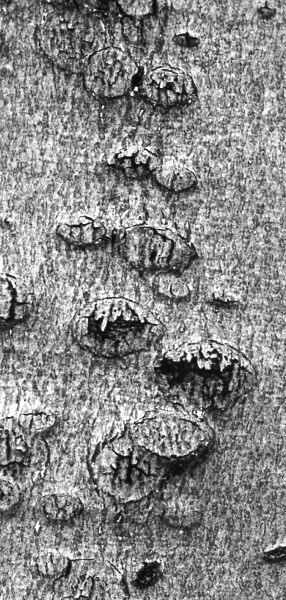
Tortured Landscape #1

Comments (click to expand)